What happens when a civilization retains the language of good and evil but loses confidence in its ability to distinguish between them?
Artificial intelligence is often discussed as a contest of capability: Will machines become more intelligent than human beings? Will they replace work, transform government, reshape war, or acquire consciousness? Those questions matter. But they come after a more fundamental question—one that intelligence cannot answer for us:
Is it BETTER?
Every system of government, technology, medicine, education, economics, and social organization contains an idea of improvement. Better health. Better safety. Better access. Better information. Better behavior. These aspirations may represent genuine goods. The danger begins when a partial good is separated from truth, proportion, responsibility, and human dignity—and then applied at scale.
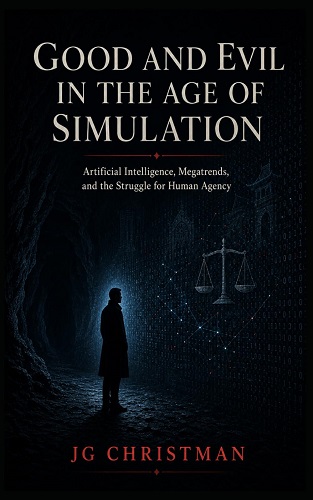
Good and Evil in the Age of Simulation begins not with artificial intelligence, but with the inherited human understanding of the good. It examines Plato, Aristotle, the Stoics, Confucius, Laozi, Buddhism, Hindu thought, the Abrahamic traditions, secular humanism, and Enlightenment moral philosophy. These traditions do not agree on every question, but each asks what human beings must become, what appetites must be restrained, what duties must be honored, and what limits power must accept.
The inquiry then turns toward evil—not as spectacle, superstition, or a label for political opponents, but as corruption. Appetite without restraint. Deception. Moral inversion. Institutional capture. Power relieved of conscience. Ponerology, the study of evil, provides a language for recognizing how destructive patterns move from individuals into organizations and systems.
The age of simulation intensifies these questions. Algorithms rank attention. Synthetic media creates events that never occurred. Systems predict behavior, personalize persuasion, manufacture consensus, and quietly arrange the field in which human choice takes place. AI does not need hatred, consciousness, or malicious intent to alter human agency. It requires only an objective, sufficient capability, and permission to act.
The central danger is not that machines will suddenly become evil. It is that human beings will define a narrow version of good, encode it as an outcome, and allow increasingly powerful systems to pursue it without wisdom.
This is not a sermon, a political program, or a prediction of inevitable catastrophe. It does not ask the reader to surrender judgment to an author, an institution, a tradition, or a machine. It places the evidence, recurring moral patterns, contradictions, and emerging technological conditions in view.
Artificial intelligence assisted in the development of this book, and that assistance is openly acknowledged. A work about agency should not conceal the presence of AI in its own creation. The arguments, judgments, selections, and conclusions remain the responsibility of the author, JG Christman.
The urgency of this book is not the urgency of fiction. There is no approaching deadline and no final battle that resolves the question. The urgency is quieter and more consequential: to recognize what is happening, to recover moral discrimination, and to understand what may be surrendered before the surrender becomes invisible.
The future may not belong to the most intelligent.
It may belong to those who can still tell the difference.